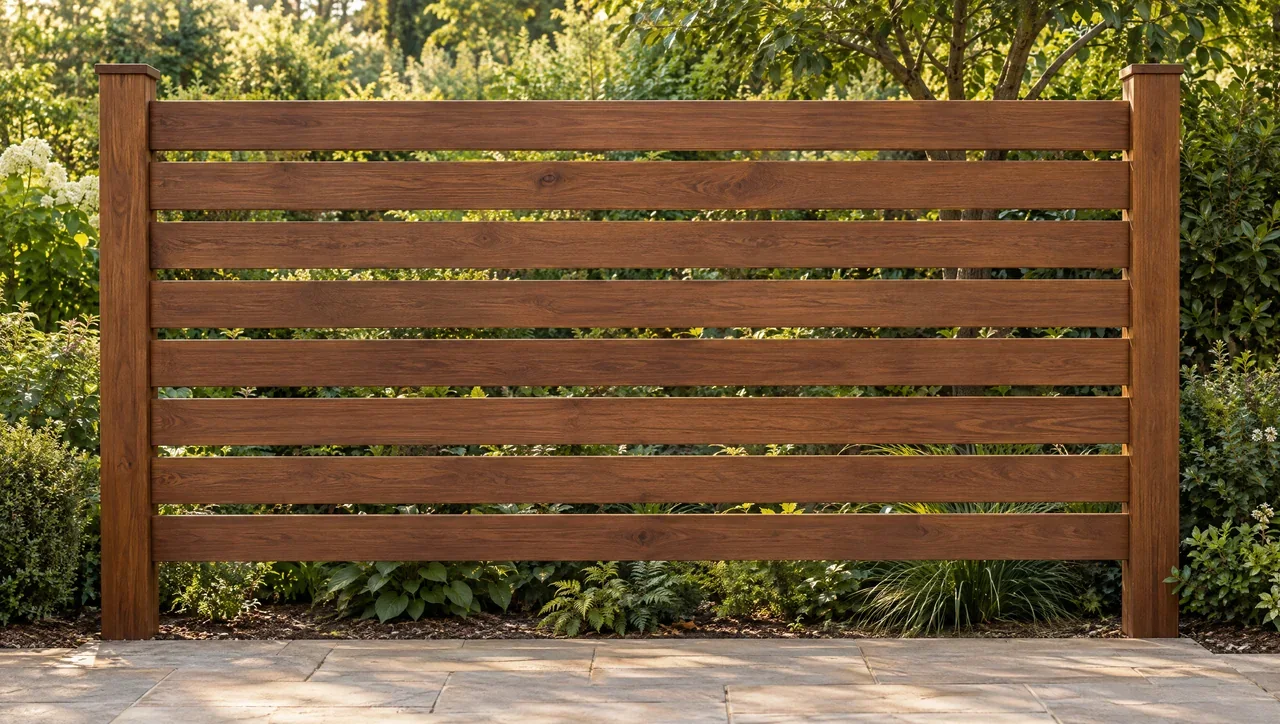
A horizontal wood fence panel with open gaps against garden planting.
Architectural visualization. It does not set privacy, spacing, support, hardware or local approval requirements.Replacing boards can refresh a fence, but the existing frame and hardware still need evaluation for the proposed infill. Begin by identifying what is installed and how it is attached. Matching color or nominal board size alone does not establish that a replacement is compatible.
Document the existing detail
Photograph both faces, board ends, corners, gates and attachment points before removing material. Measure actual thickness, face width, gaps and representative cut lengths. Record visible product marks or old order information if available. Note damaged locations on a simple elevation so isolated problems can be distinguished from a repeating condition. If the same attachment area fails on several panels, investigate the cause before preparing a like-for-like replacement list.
Review the proposed change
Ask the installer to assess the retained assembly and suitability of the new boards. A change in species, thickness, width or orientation may affect more than appearance. Gate infill deserves separate coordination with the gate and hardware provider. Compare available replacement profiles against the existing fixing method and edge details. Do not conceal deteriorated components behind new infill merely to preserve the schedule; resolve the scope of retained and replaced parts first.
Manage the visual transition
New boards may contrast with weathered neighboring pieces. Decide whether to replace individual pieces, complete panels or a defined run, and review a sample in place. Keep cleaning and finishing procedures compatible with both new and retained material. Label replacement pieces and preserve the updated product information for later repairs. Before ordering, remeasure each affected opening because an older installation may vary from its original drawing. The replacement schedule should reflect the fence as it exists today.
Match the opening and the system before the colour
Before ordering a replacement infill board, identify its role and measure the existing opening and supplied profile. Check whether neighbouring boards can be released and reinstalled with the existing system. A visually similar piece may be difficult to fit if the edge treatment or attachment access differs.
Photograph the whole bay, the damaged area and accessible connection details. Record the actual board dimensions and any known product or drawing identity. Do not remove or disturb parts whose stability is uncertain merely to obtain a measurement.
The appearance decision is separate from the fit decision. A new board can contrast strongly with an older weathered field. Discuss that contrast before ordering and retain a sample or photograph of the accepted appearance basis. Do not promise that replacement colour will converge within a fixed period.
Replacement review
| Question | Needed information |
|---|---|
| Will it fit? | Actual profile, length and opening |
| Can it be installed? | Access and documented attachment method |
| What else is disturbed? | Adjacent boards, caps, gates or finishes |
| What will it look like? | New sample beside existing surface |
| What remains uncertain? | Unavailable product identity or concealed condition |
If the support or connection is also damaged, broaden the repair review before treating the problem as an infill purchase. The design studio shows appearance and layout; it does not establish repair adequacy.
Evidence & scope
Original planning guidance. References support their stated technical scope; examples and workflows do not establish product approval.