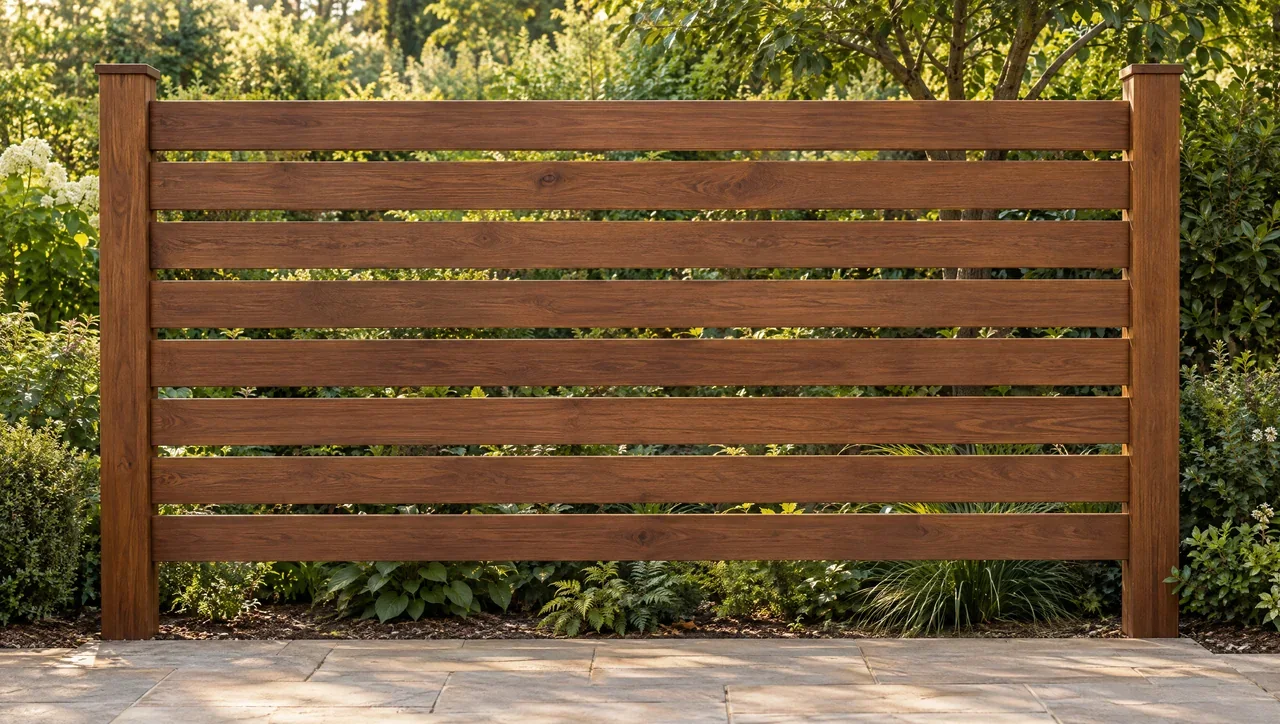
A horizontal wood fence panel with open gaps against garden planting.
Architectural visualization. It does not set privacy, spacing, support, hardware or local approval requirements.Select a species using a representative sample and the supplied product specification. Color, workability, moisture condition and the complete installed assembly matter more than a hardness ranking.
Build a useful shortlist
Start with three decisions: the appearance you want now, whether you intend to maintain color, and the assembly you can build and service. A brown horizontal fence photographed immediately after oiling is a different proposition from a naturally weathered screen. The wood choice should fit both. Ask for several sample pieces, ideally including the available color range and both faces, and view them outside beside the actual masonry, paving and metal finish.
Tropical hardwood names often describe a commercial group or a familiar marketing comparison. Brazilian walnut is not domestic walnut; Brazilian teak is not necessarily true teak; Brazilian cherry is not North American cherry. Request botanical identification when performance, substitution or documentation depends on it. Red Balau, Brown Balau and other Balau names should not be treated as interchangeable specifications. A substitute needs a new review of dimensions, moisture, connections, appearance and finishing.
Species comparison for the fence face
| Species / trade name | Typical visual direction | Practical decision |
|---|---|---|
| Ipe / Brazilian walnut | Brown with olive and darker variation | Dense boards demand planned drilling and handling; approve the full color range. |
| Cumaru / Brazilian teak | Golden brown to reddish brown | Check supplied moisture condition and sort for appearance; plan machining rather than expecting a softwood workflow. |
| Garapa / Brazilian ash | Pale honey to golden tones | Useful for a lighter palette; test the finish because it changes the apparent color. |
| Red Balau / Batu | Warm red-brown, sometimes mahogany-like | Confirm identity and supplied grade rather than specifying by color alone. |
| Tigerwood / Goncalo Alves | Warm background with dramatic dark striping | Distribute strongly figured boards intentionally; order from a representative range. |
| Massaranduba / Brazilian redwood | Red to deeper red-brown | Confirm drying and movement guidance; plan handling and inspect for checking. |
| Jatoba / Brazilian cherry | Orange and red-brown character | Confirm suitability and exterior supply specification; interior flooring stock is not an automatic substitute. |
| Purpleheart | Purple when freshly exposed, changing with light and age | Use samples and realistic color expectations; the original purple is not permanent. |
| Brown Balau and other trade groups | Variable brown palettes | Obtain a precise identity and product data before comparing with other Balau offers. |
This table describes a visual starting point, not a strength, durability or climate ranking. A board’s appearance varies within the species and changes with preparation, finish and exposure. Density and hardness do not establish the permissible distance between supports. Outdoor performance depends on the supplied material and construction details, including protection from persistent wetting and the way board ends and fasteners are arranged.
Match board size to the pattern and support
Common catalog labels include 1×4, 1×6, 5/4×4 and 5/4×6 for faces, and larger sections for rails and caps. Some suppliers also offer half-inch resawn boards or custom milling. Treat those as product options rather than a universal fence recipe. The finished dimensions must be written into the schedule. A thinner board may reduce cladding mass and purchased volume, but it can change stiffness, fastener engagement, support requirements and resistance to damage.
For mixed-width designs, draw one complete repeat using measured faces and gaps. Ripping a wide board into two narrow boards loses material to the saw kerf and creates fresh edges requiring preparation. It may also alter the approved connection detail. A nominal wide board cannot simply be counted as two finished narrow pieces of the expected face width. Include milling labor, edge treatment, rejects and any constraints on minimum widths.
Horizontal boards need a joint plan. Decide whether ends land on supports, pass behind a cover strip or enter a designed track. Available stock length is a purchasing constraint, not proof of an acceptable span. Shorter stock may work well where supports and joints are designed for it; longer stock may reduce visible joints but increase freight and handling. Compare the actual cut yield and installed result rather than assuming either short or long boards are always cheaper.
Compare other materials fairly
| Alternative | Reason to consider it | Questions for a fair comparison |
|---|---|---|
| Cedar | Lower handling weight and familiar machining | Heartwood/sapwood content, grade, actual dimensions, damage resistance and complete maintenance plan |
| Redwood | Warm color and an established exterior aesthetic | Supplied grade, heartwood content, availability and proposed support details |
| Cypress | Regional availability and a light natural palette | Actual species, age/material characteristics, exterior suitability and product documentation |
| Pressure-treated softwood | A different material and procurement route | Treatment suitability for each exposure, cut-end instructions, drying and connector compatibility |
| Thermally modified wood | Changed color and moisture behavior | Product-specific strength, fastening, span, edge-distance and exterior-use instructions |
| Composite / PVC | A manufactured color and surface system | Fence-specific approved components, thermal movement, framing and repair options |
| Metal | A different openness, weight and finish strategy | Corrosion, thermal behavior, privacy, foundations and replacement finish availability |
A softer or lighter species can be a reasonable choice when its assembly, appearance and ownership needs fit the project. Avoid comparing a premium hardwood board with an unspecified low-grade alternative. Match height, privacy, number of faces, gate construction, access and work scope first. Broad labels such as maintenance-free hide the fact that all complete fences need inspection and gates need adjustment and care.
Evaluate finish, exposure and sourcing
If you want to keep a colored appearance, compare exterior finishes intended for the supplied wood and service conditions. Make a sample, follow surface preparation and application instructions, and evaluate it after drying. Penetrating finishes and film-forming coatings require different future preparation. Do not apply a familiar interior coating just because the wood shares an interior flooring trade name. Request instructions for reapplication and any limitations on horizontal caps or exposed end grain.
If you prefer natural weathering, expect the fence to change unevenly. Sun, shade, sprinklers, adjacent planting and the sheltered face behind a post affect the result. A silver concept image is a direction, not a promise that every board will become the same gray at the same time. Cleaning, drainage checks, fastener inspection and gate service remain necessary even when color restoration is not part of the plan.
Ask the seller for species identity, origin information and whatever procurement documents your project requires. Treat environmental descriptions as claims that need relevant supporting evidence for the actual order. Avoid assuming a label on a website applies to every batch. Keep supplied records with the invoice and material schedule, and repeat the review if the source or species changes.
Approve the species with a short buying record
- Record species identity and accepted substitutions.
- Confirm actual thickness, face width, edge/profile and length mix.
- Agree on grade criteria and whether one or both faces are appearance-critical.
- Approve a range of boards rather than one ideal sample.
- Confirm moisture condition, storage and installation guidance.
- Test the selected finish or document natural-weathering expectations.
- Confirm compatibility of fasteners, connections and metal components.
- Check stock yield, milling needs, freight constraints and spare-board availability.
Keep the approved sample labeled with the species, supplier, finish, preparation and date. Take photographs as a convenient record, while recognizing that a screen does not reproduce wood color reliably. Before the full installation, approve an assembled first bay that includes the fasteners, actual gaps and adjacent metal or trim. This catches a mismatch between a loose sample and the finished fence while it is still practical to adjust the plan.
Evidence & scope
Primary technical reference for wood moisture, dimensional behavior, fastening and material properties. It does not prescribe this site’s fence layouts or certify any product.
Pool-barrier context, including climbability and gate considerations. Confirm the current local requirements and exact proposed assembly.
Original planning guidance. References support their stated technical scope; examples and workflows do not establish product approval.